
Which German Level Do You Need for the Chancenkarte (Opportunity Card)?
A1 gets you in the door, but every level up earns points toward the Chancenkarte — here's exactly what German you need.
Short answer: you need at least German A1 to qualify for the Chancenkarte — or English B2 if your German isn't there yet. But the more German you bring, the more points you earn, and points are what get you the card.
What the Chancenkarte actually is
The Chancenkarte, or Opportunity Card, is a job-seeker residence permit (Section 20a of the Residence Act, introduced in June 2024). It lets you come to Germany to look for work — without a job offer in hand.
It runs on a points system. You need at least 6 points, and your German level is one of the easiest ways to collect them. If you're weighing a move, my German for moving to Germany track is built around exactly this.
How German level earns you points
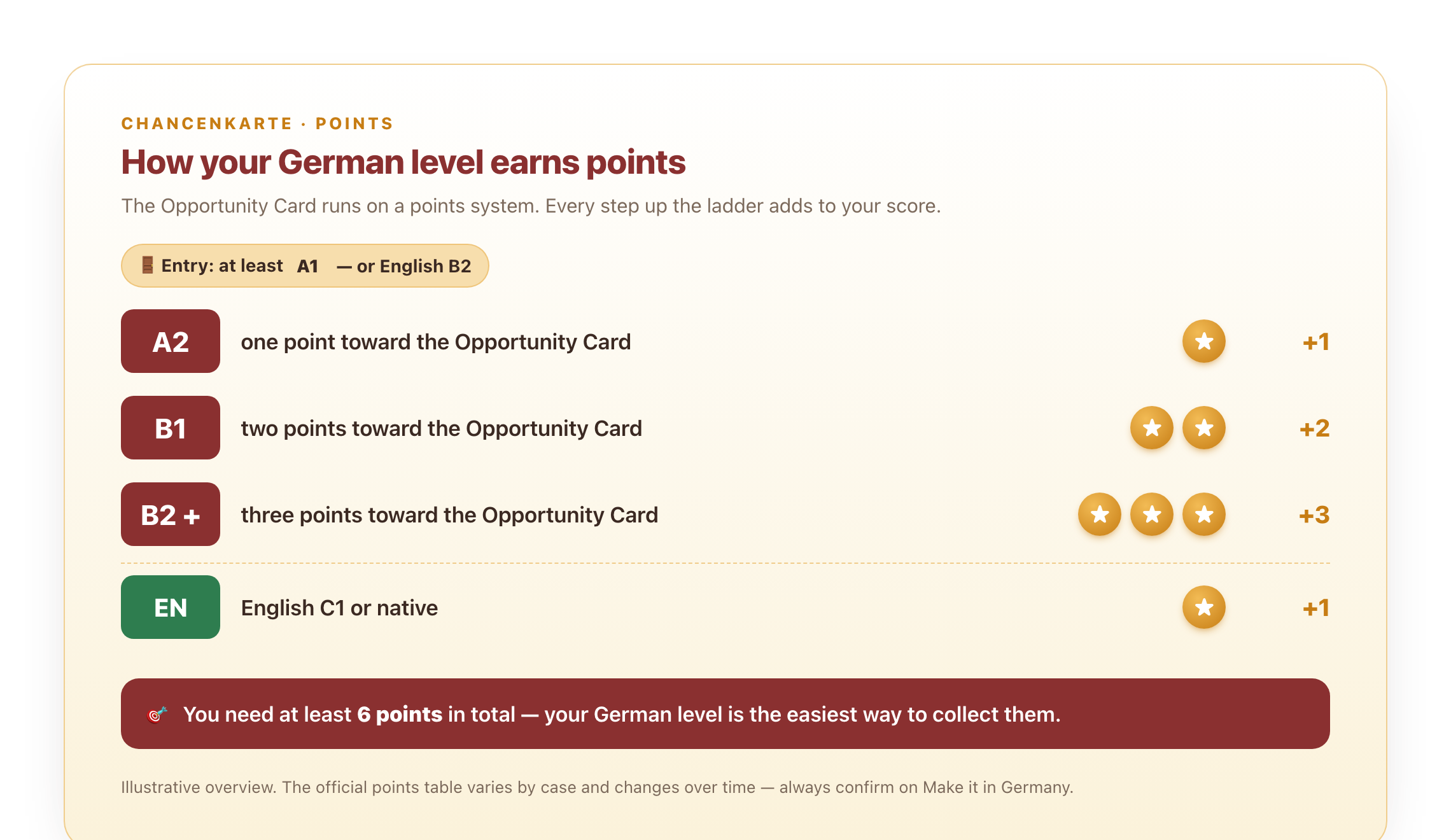
Every step up the ladder adds points:
- A2 — 1 point
- B1 — 2 points
- B2 or higher — 3 points
English counts too: C1 or native English adds a point. So A1 gets you in the door, but B1 or B2 does the heavy lifting on your score.
Not sure what these levels mean? I break them all down in this guide to A1 through C1.
How long does that take?
A1 is a few months of steady work. B1 is a bigger commitment, but very doable with a plan. I've laid out realistic timelines in how long it takes to reach A1, B1 and B2.
One more thing: if your spouse joins you, they generally need basic German at A1 too. Plan for both of you.
A quick, honest caveat
You can technically arrive without speaking a word of German. But more German means more points — and a real head start finding work and settling in.
The exact points table and the rules vary by case and change over time, so always confirm with the official source: Make it in Germany and the German mission handling your application.
Want a head start on those points? Start your 5-day free trial and see how fast A1 can come together. 🚀